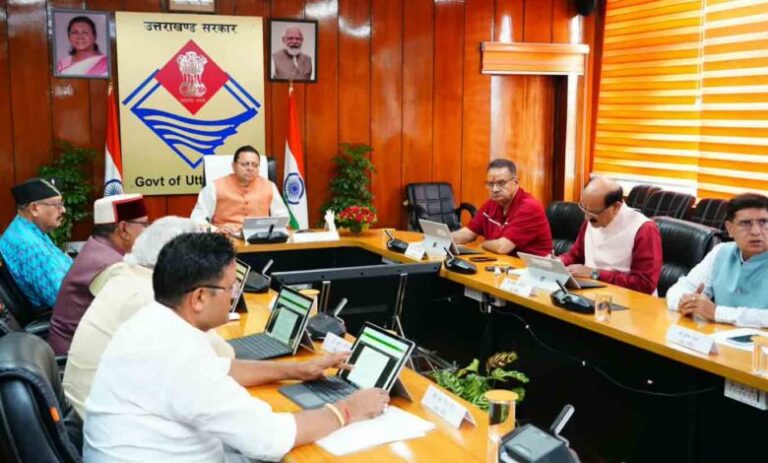
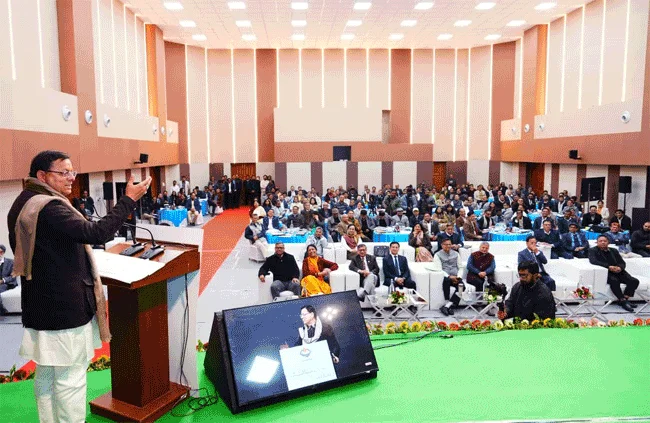
Uttarakhand Chief Minister Pushkar Singh Dhami addressed the state’s administrative officers on Friday at the Chintan Shivir (brainstorming session) and Dialogue on Vision 2047 held at the Civil Services Institute. Chief Minister Pushkar Singh Dhami said that through this two-day camp, a concrete, practical, and time-bound strategy will be prepared to make India a developed nation by 2047, in line with Prime Minister Narendra Modi’s vision. During this session, in-depth discussions will be held on all major sectors related to the overall development of Uttarakhand. This will help in setting a clear, practical, and time-bound direction for the future of the state.
Chief Minister Dhami said that the resolution to make India a fully developed nation by 2047 can only be realized when every state in the country is equally developed. For this, Uttarakhand must also determine a clear and long-term direction for development in accordance with its resources, capabilities, and unique characteristics.
He said that the vision of a developed India presented by the Prime Minister is not limited to any one government, any one term, or any one scheme, but it is a comprehensive and long-term national vision that encompasses the resolve to establish India as an economically, socially, technologically, strategically, and culturally strong, self-reliant, and globally leading nation. The greatest feature of this vision is that development is not limited to mere statistics, but is made human-centric, inclusive, and sustainable. A developed India means building an India where every citizen has equal opportunities, where the governance system is transparent, sensitive, and people-centric.
Role of the Administrative System
The Chief Minister said that the success of any policy, from its formulation to its implementation and final outcome, depends on the activeness, sensitivity, and efficiency of the administration. Therefore, the role of the administrative system is extremely important in realizing this vision. For this, our administration will not only have to work with speed and transparency, but also implement every policy, decision, and plan with a ‘target-oriented’ and ‘people-centric’ approach. The Chief Minister instructed the officials not to limit their work to merely issuing orders or holding meetings, but to complete every task within their purview with promptness and accountability, adopting an innovative, transparent, time-bound, and results-oriented approach. Chief Minister Dhami said that today we are creating a roadmap to realize the vision of a developed Uttarakhand contributing to a developed India. This should not be limited to merely formulating plans and policies or setting targets, but we must see what changes our plans and policies will bring to the lives of ordinary citizens. For this, we need to focus on parameters such as increasing farmers’ income, creating employment opportunities for the youth, and ensuring equal opportunities for women. He said that achieving these goals will determine the true measure of a developed Uttarakhand and a developed India.
Work like Team Uttarakhand
Chief Minister Dhami said that as a hilly state, we face some unique challenges, but within these challenges lie numerous opportunities. If we adapt our policies and plans to the state’s geographical conditions, local needs, and future requirements, Uttarakhand can strike a balance between economy and ecology and give a new direction to development in the country. For this, we must determine the level our state should reach in areas such as education, health, industry, tourism, agriculture, energy, technology, and good governance by the year 2047.
At the same time, rising above departmental boundaries, we must establish coordination among all departments to realize Vision 2047 and prepare a clear action plan for the next twenty-five years. He said that we must rise above the “solo player” mentality and work as “Team Uttarakhand.” He asked the officials to pay special attention to the development of the place where they started their service. He also instructed them to note down the public grievances that come to light during the “Government for the People, at the People’s Doorstep” program and resolve them.
Foundation of Developed Uttarakhand
In his address, the Chief Minister said that the foundation of a developed Uttarakhand rests on three pillars: good governance, technology and innovation, and people-centric, sustainable, and balanced development. Good governance means not only following rules and procedures, but also ensuring that every decision is made on time, every plan is transparent, and every officer is accountable for their responsibilities. He said that we must make governance more effective, faster, and more transparent by using modern technologies, including e-governance, artificial intelligence, and data analytics. At the same time, we must ensure that technology is not limited to urban areas but reaches even the remotest and most marginalized villages.
Furthermore, the welfare of ordinary citizens must be paramount in our policies and plans. He said that public trust is the greatest asset of the administration, and maintaining it should be our highest priority. The Chief Minister said that in an environmentally sensitive state like Uttarakhand, maintaining a balance between development and the environment is extremely important. We must make disaster management an integral part of our development planning.
Define Outputs and Outcomes
He said that officers must define clear outputs and outcomes for each scheme. Simply spending money is not enough.
About the Author